14. The Dining Server Problem
A restaurant-kitchen analogy for load balancing and flow control in distributed systems, and why it teaches concurrency better than the classic Dining Philosophers problem
This Article: guleria.ai/blog/dining-server-problem
When I was first learning about concurrency, the professor’s go-to example was the Dining Philosophers problem: five thinkers at a table, five forks between them, and a very real risk that everyone reaches for a fork at the same time and nobody eats. It’s a great way to teach deadlocks. But it never quite matched what I actually run into as an engineer.
What keeps me up at night isn’t a handful of philosophers stuck mid-thought — it’s the version of this problem that Google, Amazon, and every busy API deal with every second: how do you keep a limited set of workers fed with a constantly shifting stream of requests, without anyone starving and without anything going cold? I’ve started calling this the “Dining Server Problem,” and I think it’s a far better mental model for how real systems behave under load.
The Setting: A Busy Kitchen
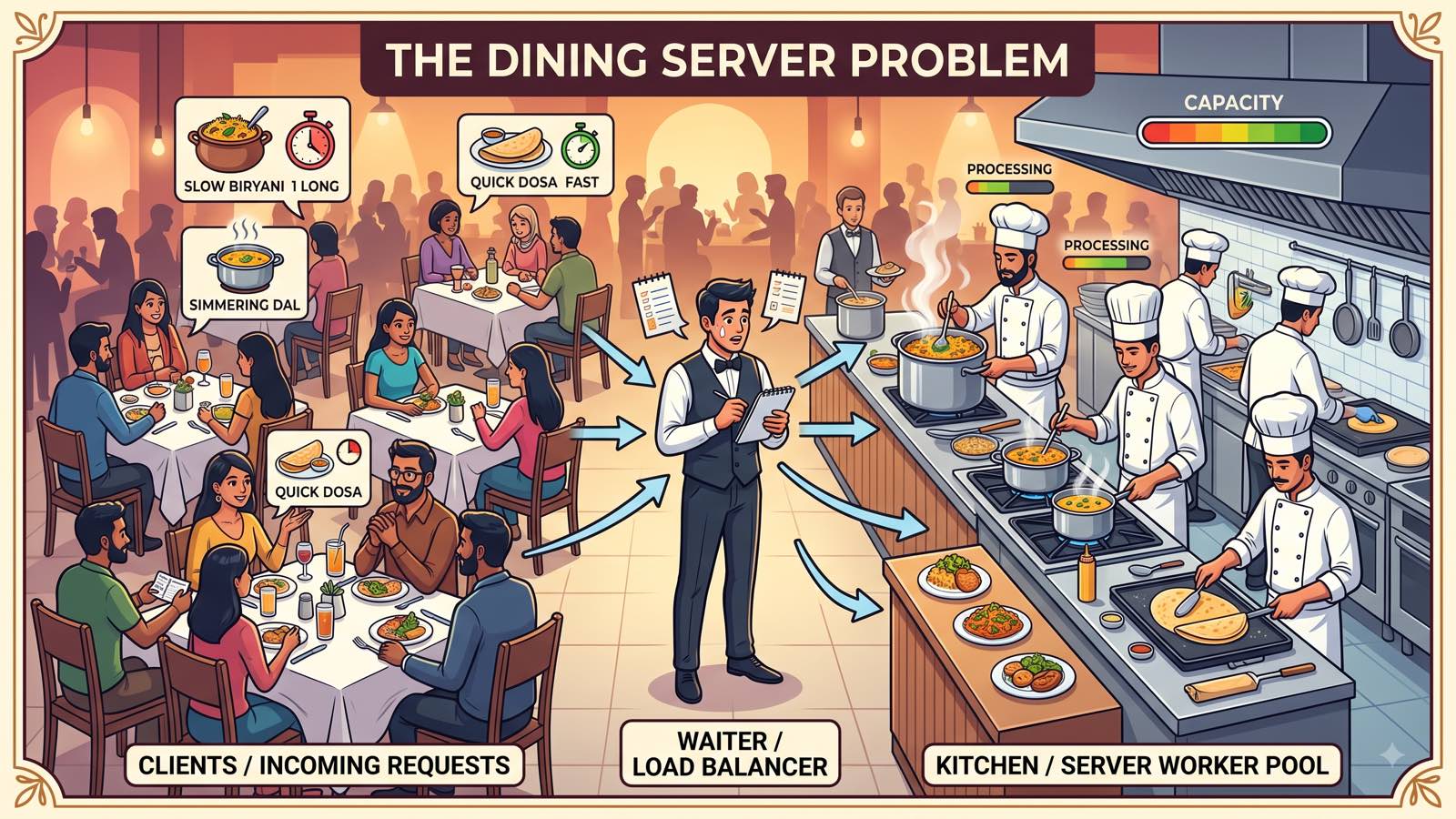
Picture a packed restaurant on a Saturday night. One table orders a slow-cooked biryani and a dal that needs to simmer. Another just wants a quick dosa. Everyone wants their food, and everyone wants it now.
Map that onto a system:
- The kitchen is the server (or worker pool) — it can only cook so much at once.
- The tables are the clients — each one represents an incoming request.
- The waiter is the load balancer, deciding who gets the kitchen’s attention and when.
Efficiency vs. Fairness
This is where it stops being a story about food and starts being a real problem in distributed systems and queueing theory: how do you spread a fluctuating workload across limited resources and keep as many people happy as possible?
I think about it as two competing waiter strategies:
- Round-robin (fairness). The waiter checks on Table A, then B, then C, in order, no matter what. Nobody gets ignored, but a table with a complicated order and a table that just wants water get treated identically, which isn’t always efficient.
- Priority-based (efficiency). The waiter serves whoever’s order is ready or whoever’s waited longest. This is closer to how a network router or scheduler behaves — it optimizes for throughput, sometimes at the cost of strict fairness.
Neither strategy is “correct” in isolation. Production systems usually end up blending both.
So, Which Strategy Actually Wins?
In practice, neither pure round-robin nor pure priority-based routing survives contact with a real kitchen. What production systems actually do is blend the two, using a few concrete techniques:
- Weighted round-robin. Not every “cook” (server) is equal — some have more capacity than others. Instead of strict A-B-C rotation, faster workers get more of the rotation’s turns, proportional to what they can actually handle.
- Least-connections routing. Rather than rotating blindly, the waiter sends the next order to whichever cook currently has the fewest dishes in progress. This is the priority-based idea made concrete: route to whoever’s actually free, not just whoever’s “next in line.”
- Bounded queues with backpressure. The kitchen doesn’t accept infinite orders. Once the ticket rail is full, the waiter stops taking new orders — or tells incoming tables to wait — rather than letting the kitchen collapse under a backlog it can’t clear. This is what rate limiting and admission control do in a real system.
- Aging. To stop the priority approach from starving the small orders (a dosa order stuck behind an endless stream of biryanis), tickets that have waited long enough get bumped up in priority automatically. This is the same trick priority schedulers use to guarantee fairness without sacrificing throughput.
- Elastic capacity. If the dinner rush is bigger than the kitchen can handle no matter how cleverly it schedules, the real fix is adding another cook — the restaurant equivalent of autoscaling.
None of these are exotic — they’re the same primitives behind every production load balancer (NGINX, Envoy, AWS ALB) and job scheduler. The “strategy” isn’t really a single algorithm; it’s a policy that combines routing, backpressure, and fairness guarantees, tuned for the specific shape of the workload.
The Hot Food Problem: Latency
Here’s the part that makes this more interesting than a simple scheduling puzzle: food gets cold. Biryani that sits on the counter too long stops being good biryani, the same way a request that sits in a queue too long times out.
That creates a real tension:
- Let the kitchen focus entirely on one big, complex order, and every other table starts waiting too long.
- Let the kitchen try to cook everything at once, and it gets overwhelmed and slows down for everyone.
Every load balancer, scheduler, and autoscaler is, in some form, trying to walk this same line.
Why I Prefer This Over Dining Philosophers
Dining Philosophers is about deadlocks — how to stop a system from freezing entirely. The Dining Server Problem is about flow control and load balancing — how to keep a system fast and fair while it’s still running. Both matter, but the second one maps much more directly onto the systems I actually build and debug:
- Cloud infrastructure: how does AWS decide which instance handles your request?
- Operating systems: how does a CPU scheduler decide which process runs next?
- Networking: how does a router stop one large download from choking everyone else’s connection?
The Takeaway
The Dining Server Problem is really about resource orchestration — not just “does this work,” but “does this stay fast and fair under pressure.” The goal is a kitchen that’s never idle, customers who never wait too long, and food that’s still hot when it reaches the table.
Solve that, and you’re not just running a better restaurant — you’re building systems that hold up under real-world load.